Look Back Before You Move Forward
A God-Centred Year in Review
Why I still do this before I plan anything new
Every January, before I set a single goal, I look back.
Not because I am sentimental (I am). Not because I love nostalgia (I do). But because I have learned that if I do not stop to look back with God, I will move forward without Him.
And I know what both of those feel like.
I started doing this years ago when life felt loud and full, and I could not figure out why I always felt slightly behind. Behind on plans. Behind on decisions. Behind on what I thought I should be doing.
So one January, instead of planning, I paused.
I grabbed a notebook, sat at the table before anyone else was awake, and started writing down what the last year had actually been like with God in it.

What He had done. What He had said. What I had learned. What I had survived. What I had forgotten to thank Him for.
That morning changed the way I approach every year.
Because looking back is not just reflection. It is remembrance.
In the Old Testament, when God brought the Israelites through something significant, they did not just move on. They stopped and made a mark. They built a memorial. They stacked stones. They created a physical reminder so that when they passed that place again, they would remember what God had done there.
I think we forget to do that.
We rush into the next thing without taking time to notice what God just brought us through.
The hard season. The answered prayer. The quiet growth. The unexpected turn. The provision we did not see coming. The strength we did not know we had.
So every January, I take time to “stack stones” in my own way.
I write. I reflect. I remember.
Because there were years when I jumped straight into planning, calendars, strategy, and goals. Those years looked productive from the outside. They were full. Busy. Successful by most measures.
But inside, they felt rushed. Noisy. Slightly out of step.
Then there were years when I slowed down long enough to reflect before I planned. Those years felt different. I could recognize God’s timing more easily. I could say no without guilt. I could see where He was already at work instead of trying to create momentum on my own.
That difference is why I still do this.
This is not a devotional exercise for me. It is a life practice. A leadership practice. A discernment practice.
Before I look forward, I look back.
Before I plan, I listen.
Before I say yes to anything new, I pay attention to what God has already been doing.
This is the simple process I use every January.
If you have never done a year-in-review like this, now is the perfect time to start.
The 7 Questions I Ask Every Year
I do not rush this part. I take a notebook, and I write slowly and honestly.
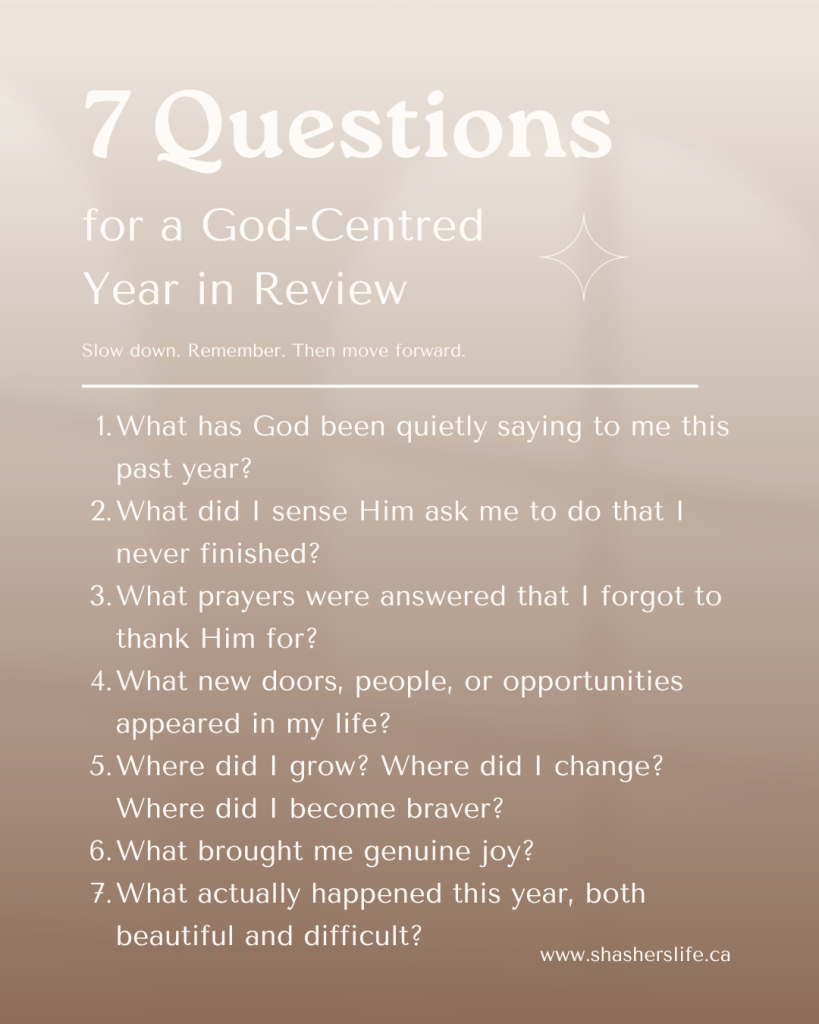
This is where patterns begin to show up.
Themes. Nudges. Invitations. Gentle corrections. New directions.
You start to see God’s timing in hindsight, which is the only way you learn to recognize it in real time.
The Two Lists That Quietly Shape My Year
Once I finish the questions, I make two lists.
What do I want MORE of this year?
More margin. More time with people who matter. More joy. More obedience. More conversations that count. More work that lasts.
What do I want LESS of this year?
Less distraction. Less overcommitment. Less noise. Less “good things” that crowd out the right things.
This is where clarity begins.
Because saying yes to MORE almost always requires saying no to something that looks perfectly reasonable.
Wisdom is rarely choosing between good and bad. It is choosing between good and right.
A Simple Framework I Return To Each Year, BELT
I came across this acronym years ago, and the framework has stayed with me because of how practical it is. I return to it every year as a way to reset my thinking.
B — Build a Daily Foundation
This does not have to be complicated or impressive.
It is simply time with God before emails, news, and other voices get access to me.
Some days it is quiet with a journal. Some days it is messy. Some days it is worship in the car.
And some days, it is as simple as lingering in bed for a few extra minutes, eyes still closed, not even using my voice yet, just saying hello to Him before I say hello to the world.
But every day, I begin here.
Because how I start my day usually shapes how I walk through it.
E — Eliminate Fear
Fear is not always loud.
Most of the time, it is subtle. It disguises itself as caution, busyness, responsibility, overthinking, or the need to control outcomes.
It sounds reasonable. It feels wise. It even looks productive.
But fear keeps you small.
Perfect love does not.
We are living in a time where anxiety feels almost normal. The world feels unstable. News cycles are relentless. Opinions are loud. Everything feels urgent. It is very easy to carry a low level of fear without even realizing it.
And that fear quietly starts shaping decisions.
What we say yes to. What we avoid. Where we hesitate. Where we play it safe.
So every year, I ask myself a hard question.
Where did fear influence my decisions this past year?
Where did I hold back? Where did I delay obedience? Where did I choose comfort over courage?
Not to shame myself, but to bring it into the light.
Because Scripture says perfect love casts out all fear. Not will cast out. Casts out. Present tense.
Which means when fear is present, it is often a sign that I need to come back under the covering of God’s love and truth again.
Naming it is the first step to dealing with it.
And dealing with it is what makes space for courage in the year ahead.
L — Learn to Discern God’s Voice Again
God rarely speaks to me this year the way He did last year.
The mistake I have made more than once is trying to reuse old instructions in a new season. Assuming that because something worked before, it must be what God is saying now.
But discernment does not work like that.
Discernment is not hearing louder. It is listening more closely.
And if I am too busy, too distracted, too full of my own plans, it becomes very easy to miss the gentle way God is leading.
Discernment takes maturity, not in age, but in faith.
It is the ability to recognize the difference between my own urgency and His timing. Between my own ideas and His direction. Between a good opportunity and a God invitation.
That kind of listening takes practice.
It takes quiet. It takes patience. It takes a willingness to admit that I do not already know the answer.
So every year, I ask myself, am I still listening the way I used to? Or have I started assuming?
Because discernment is not a skill you master once. It is a posture you return to again and again.
And returning to it is what keeps me in step with Him instead of running ahead.
T — Transform Limiting Beliefs
Many of the beliefs we operate from were formed long before we were adults.
Long before we had faith. Long before we had wisdom. Long before we had any real understanding of who God is or who we are in Him.
And yet, those old beliefs still whisper.
“I’m not ready.”
“I’m too late.”
“I’m not qualified.”
“I always do this wrong.”
“This is just how I am.”
They sound familiar because we have been hearing them for years. So we mistake them for truth.
But none of those come from God.
Over time, I have learned that some of the biggest things God wanted to do in my life were not blocked by circumstances. They were blocked by what I believed about myself.
Beliefs I never questioned. Assumptions I never challenged.
So every year, I ask myself, what did I believe about myself this past year that God never said?
Where did I limit myself because of an old story I was still telling?
Then I deliberately replace it with what is true.
“I can do all things through Christ who strengthens me.”
“I am a new creation in Christ.”
Not as a slogan, but as a reset.
Because truth, repeated over time, quietly reshapes how you see yourself. And how you see yourself shapes how you walk into what God is asking you to do next.
Why This Matters More Than Goal Setting
I still set goals. I still plan.
But this comes first.
Because I have learned that this is not really about productivity. It is about alignment.
And alignment changes the way the whole year feels.
When I take time to do this first, I notice something shifts. I am not scrambling for direction. I am not trying to force momentum. I am not reacting to everything that comes at me.
I move into the year steadier. Clearer. More settled.
I can recognize what is mine to carry and what is not.
I can say yes with confidence and no without guilt.
I stop chasing what looks urgent and start responding to what God is actually doing.
I stop striving to make things happen and start walking in step with what is already unfolding.
And perhaps most importantly, I get better at recognizing God’s timing when it appears, because I have just spent time remembering how He moved in the past.
That changes everything about how I step into what is next.
Before You Plan What Is Next
Before you rush into the new year, pause long enough to see what God has already done.
Take a notebook. Set aside an hour. Sit somewhere quiet. Work through the seven questions slowly.
Make your MORE and LESS lists.
Stack a few stones of remembrance.
Not because it is a nice exercise. But because remembering changes how you move forward.
You may find that the direction you have been searching for is already woven through what you have lived. That God has been speaking more clearly than you realized. That courage for what lies ahead is hidden in gratitude for what has been.
And when you take the time to notice that, you do not step into the year hurried or unsure.
You step into it grounded. Aware. Ready to walk in step with Him.